

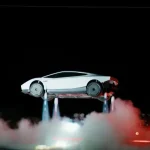




Elon Musk, CEO of Tesla, has shown a new version of the Roadster which he states is capable of carrying out spectacular aerial moves by means of high-pressure air jets. That said, doubts still exist as to whether the car can maintain flight.
On October 15 a launch event was held in Waco, Texas, at which Tesla presented its highly anticipated Roadster. While demonstrating the vehicle, Musk showed off a two-seater sports car which is intended to combine high-speed performance on the road with a range of technology meant for lifting the car into the air.
Musk stated that the car is capable of going from 0 to 60 miles per hour in under one second, and he also showed how the vehicle could climb a steep ramp, flip through the air, and then land using a system of high-pressure air jets.
The vehicle was used for the demonstration with no driver in it, and Musk stated that this decision was made in order to reduce the risk of injury during the experimental presentation.
How does Tesla’s flying Roadster function?
Musk stated that the Roadster has 10 nozzles connected to ultra-high-pressure air tanks, which are intended to provide extra thrust for flight and for rapid acceleration when on the road.
He described the technology as being based on both automotive engineering and rocket technology, using the capabilities of Tesla and SpaceX.
It is said that during the event the car jumped over a row of parked Tesla vehicles. Yet simple aerial maneuvers do not prove that a vehicle can fly over long distances or behave safely under normal conditions.
Tesla Targets Production in 2028
Musk has stated that production of the Roadster is due to begin in 2028; however, since the company has already altered the timelines for a number of major projects, the proposed production date should be regarded as a target and not as a guarantee.
There are also uncertainties concerning the vehicle’s final design, its price, the safety requirements and the practical feasibility of the flight capabilities it is said to have.
Why Flying Cars Remain Difficult to Develop
Flying cars have significant engineering difficulties. The vehicles built for use on roads need strong frames, safety features, and other parts which increase their weight. On the other hand, aircraft need to carefully manage their weight and have stable flight systems.
Before the event Roger Connor, who is a curator specializing in vertical flight at the Smithsonian’s National Air and Space Museum, pointed out these difficulties. A vehicle which is designed to be used both on the road and in flight cannot carry out either of these tasks as efficiently as a specialised car or aircraft.
Alef Aeronautics, which is a startup based in California, is also involved in this field and is developing an electric flying vehicle. The vehicle’s design involves the use of several propellers in order to lift it into the air. Yet obtaining a working prototype represents only one stage on the way to making flying cars practical and generally available.
Jim Dukhovny, the CEO of Alef, has stated that transitioning from vertical takeoff and landing to forward flight is one of the major technical problems facing electric vertical takeoff and landing aircraft, commonly known as eVTOLs.
Can the Tesla Roadster actually fly?
The main issue is whether the Tesla Roadster is capable of controlled and continuous flight or if it can carry out only short jumps and aerial stunts.
The fact that a vehicle has managed to lift off the ground does not in itself show that it has the ability to fly through the air like an aircraft; only after long-distance flight has been achieved, stability has been proven, passenger safety has been established and regulatory approval has been obtained could such a vehicle become suitable for ordinary use.
At this stage, the Roadster’s claimed ability to fly is still something that needs further technical evidence, and more information regarding its engineering, testing, and production plans will be crucial in deciding whether this concept can go beyond a dramatic demonstration.
Thinkoras will keep on reporting on developments in the field of technology, in electric vehicles, and regarding the future of transportation.

Other Articles

MLB Playoffs Reveal How Team Payrolls Could Shape Baseball’s Future